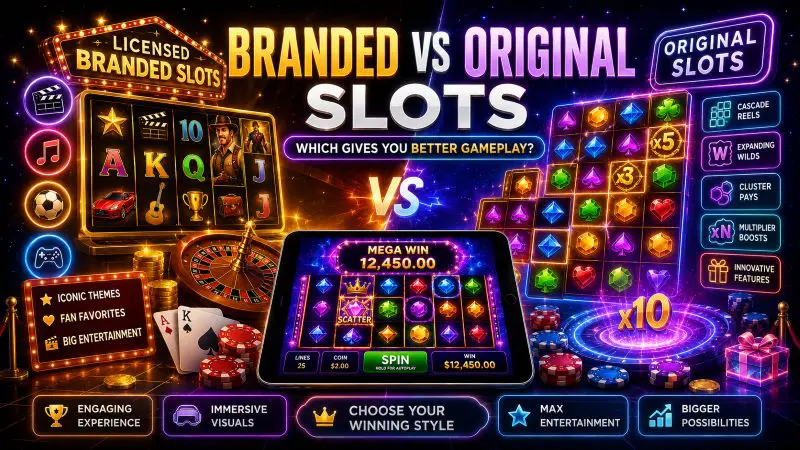
At this point, in addition to a plethora of licensed slots, such as Narcos, Ted, Jumanji, Baywatch, Deal or No Deal, and Guns N’ Roses, you’ll find countless slots that were created without reference to existing intellectual property. All are vying for your attention and all want to know whether the name on the box makes the slot a superior gaming experience, or merely more noticeable.
As someone who has bounced back-and-forth between licensed and non-licensed slots, I have some thoughts, and they’re not as black-and-white as either side may wish them to be. While a branded slot versus an original casino slot comparison is largely a battle based solely on brand recognition (which gets you to “click,”) the key is determining whether the recognition translates to a superior overall gaming experience.
What distinguishes a branded slot from an original slot?
A branded slot utilizes official licensed materials — films, television programs, musicians/music groups, celebrities, sporting brands, video games or game shows — as its central theme. This license agreement is typically binding; the developer must utilize pre-approved artwork, include the likeness of characters used in the source material (when applicable), potentially utilize actual footage or audio from the source material, and obtain approval from the licensor prior to publishing the game. For example, if a developer creates a slot game utilizing actual clips from Vikings, or a Guns N’ Roses slot game with Guns N’ Roses songs being utilized as background music during the reels spinning, that’s the purpose of paying the licensing fee.
An original slot skips all of those steps. In an original slot, the developer has complete ownership of the idea and creation from inception to completion including characters, gameplay mechanisms, art style and storyline. The developer is able to allocate the budget however they choose without needing to account for royalty payments to any third party or obtaining approval from a licensor. Examples of games that demonstrate this ability include Gonzo’s Quest and Book of Dead — both of which have become franchises in their own right due to the developers having the ability to create whatever they wanted without needing to seek approval from a licensor.
Although this seems like a simplistic explanation, it is much deeper until we examine what truly occurs beneath the surface, as the theme is merely the packaging. Every element that determines whether a slot is worth your time (i.e., math, mechanics, pace) exist below the theme.
Prior to launching a Deal or No Deal slot several years ago I loaded it primarily because I used to watch the show with my father and within 10 minutes I was so focused on how tight the free spins were that I’d forgotten why I was playing it. This is generally how it works. The licensing allows you access to the theme and therefore your first session; however it cannot carry an inferior game beyond that session and will certainly not assist you financially if the underlying math is subpar.
Why a recognizable name attracts players before the reels begin spinning
That’s another reason casinos continue to license additional IP each year. Familiar IPs provide marketing capabilities that an original title cannot achieve upon launch. If you watched Baywatch reruns as a child or have seen every Jumanji film multiple times, then a slot utilizing those IP’s has an emotional advantage. You’ve grown accustomed to the aesthetic, you enjoy the characters and that familiarity reduces the mental barrier preventing you from attempting a new game.
Nostalgia provides a measurable benefit. Official soundtracks, authentic voiceovers and actual footage from the source material create an immersive slot experience that a generic fantasy theme or fruit machine layout cannot emulate. Fans of an IP receive something akin to an interactive tribute versus a standalone gambling product. For many players that emotional reward is sufficient justification for signing in regardless of the pay table.
However recognition represents a marketing victory and not necessarily a gaming victory. A popular theme does not equate better RTP, reduced volatility or improved bonus features. A popular theme signifies better initial impressions. What transpires after those first impressions is an entirely independent conversation that many players avoid because the branding performed its function slightly too well.
The mathematical costs associated with licensing that nobody includes on the packaging
Licensing is expensive — sometimes very expensive — and ultimately that expense has to come from somewhere. Rights owners charge licensing fees and many also demand royalties. Developers creating the games have to fund legal review, brand approvals processes and ongoing compliance with representing the IP correctly. Those costs do not go towards additional reels, enhanced bonus rounds or increased maximum win amounts.
It does not follow that every branded slot has inferior mathematics than every original slot; that is an unjustified assertion and I’ve played licensed slots with mathematics equal to those of originals. However, there exists a significant trend in this regard: Providers frequently reduce RTP by a small percentage (1%), increase volatility and/or limit bonus round options in order to compensate for licensing costs while allocating a larger portion of their budget toward graphics/voice work/visual fidelity as opposed to bonus complexity. Branded slots can possess inferior RTP relative to originals; although it is not universally true — there are examples of this occurring sufficiently enough that checking RTP prior to play is rational behavior — not paranoia.
As previously discussed neither type of slot possesses any inherent superiority in regards to RNG-based mechanics that determine outcomes. There are no differences in how either type of slot generates random numbers; thus there is no mechanism for a branded slot to be rigged relative to an original slot. Similarly there are no inherent differences in how either type of slot determines winners/losers. Where licensure influences design choice is how providers allocate resources: how conservatively they approach volatility, how they permit themselves to design bonus rounds relative to their resource constraints etc.
Where original slots clearly excel
When providers have complete freedom regarding their creativity it manifests itself in unconventional areas of slot design, and nearly always these are original slots that are performing innovative functions. Without a licensor reviewing each and every aspect of their game to ensure consistency with the source material’s characteristics, providers constructing original titles ship numerous types of reel systems (e.g., cascading reels, expanding grid systems, cluster pays etc.) along with bonus structures that could never survive licensors’ review processes because they lack similarity with the source material(s).
In addition to the aforementioned advantages original slots exhibit in regards to creative freedom they also present innovative approaches toward designing math models. With greater freedom to test novel hit frequency curves or unique multiplier ladders, developers of original titles can innovate more rapidly because they do not require a film studio’s lawyers to approve their testing parameters initially. Many of the most prominent innovations developed by providers in recent years (e.g., Megaways-type mechanics and increasingly complex bonus-buy structures) began in original titles prior to their implementation in branded titles.
Economically speaking there are obvious reasons why developers prefer original titles: They are betting entirely on gameplay to generate interest among gamers because there exists no built-in audience based on a pre-existing franchise. Consequently, original titles tend to represent more thoughtful design endeavors because the elements of gameplay must accomplish the tasks that brand recognition would normally perform. While certainly not every original title succeeds in fulfilling that obligation; the upper limit for genuine innovation exists higher in regards to original titles than branded titles.
While all branded categories do not operate similarly, it is worth noting:
Music-themed slots utilizing licensed musical content possess greater flexibility than traditional film-TV licenses since musical content rarely requires protecting narrative continuity. Slots using sports-related themes exist midway between film-TV licenses and music licenses since they are required to display visual identities owned by clubs or leagues but rarely possess restrictions related to narrative continuity. Video game themed slots and game show themed slots typically represent the least restrictive branded category since both genres involve interactive aspects that can be borrowed directly by providers creating such titles.
Therefore which one is actually worth your hard earned cash
Branded and original slots are optimized for competing purposes. Licensed slots are optimized for providing emotional connections with fans of specific franchises and generating immediate familiarity with audiences. Movie-themed slots and TV-show themed slots provide entertainment value unrelated to pay tables — spending twenty minutes immersed in worlds you already enjoy. Original slots are optimized for gameplay quality in accordance with their own criteria — devoid of external influences such as emotional connections generated by licensing agreements.
Regardless of what appears on the box run through the same evaluation criteria as you would evaluate any title irrespective of licensure status. First, evaluate RTP as it is an essential factor in evaluating how many sessions you will endure prior to exhausting your bankroll. Second, assess volatility rating as two branded slots possessing identical 96% RTP can generate vastly different experiences due to differing hit frequencies/volatilities.
Third, read through max win amount listed in the pay table as it indicates how large of a payout a player can expect at most. Fourth peruse bonus round rules prior to investing real cash as “free spins with multipliers” can signify 5 very different items depending upon provider. Fifth, compare betting limits with your available bankroll as an aesthetically pleasing theme combined with poor betting limitations will quickly result in frustration for extended periods of playtime.
You may be a hardcore fan of an IP and you have determined that a licensed version of a slot possesses acceptable statistics — there is no problem with selecting it based on nostalgic appeal — nostalgia provides real quantifiable benefits and it is a valid rationale for playing. Conversely, if you prioritize payout potential, frequency of bonuses, and truly innovative mechanics — original titles statistically possess more opportunities for delivering something you haven’t seen a thousand times already.
Ultimately, the best slot (regardless of whether it falls into branded or original) is one where the theme matches your expectations regarding gameplay mechanics.
Some additional honest inquiries gamers pose prior to transitioning between categories
Does licensing cost developers less revenue due to licensing fees? Sometimes — but it’s frequent enough that it should always be factored into consideration when evaluating paytables. Licensing fees take funds from somewhere (likely RTP or bonus complexity). Always verify the paytable rather than assuming.
Are original slots riskier than branded slots because they have less proven track records? Unriskier isn’t correct; Unfamiliar is more accurate. Since no audience has been established for new original themes; reviews/community discussions surrounding these titles will likely be scarce. Math itself isn’t inherently riskier simply because you aren’t familiar with the theme.
Can a branded slot ever out-innovate an original title? Yes – though infrequently: Some licensed titles receive ample development budgets due to being a flagship release and thus spend significantly more dollars on visually enhancing their bonus rounds and developing truly innovative features. Though this is uncommon; it occurs occasionally.
Is RTP the only statistic I need consider? No. Hit frequency/volatility rate influence perceived session length far more than RTP alone. Two slots with identically 96% RTP can experience vastly different session lengths depending on hit frequency/volatility rates.
Can nostalgia ever outweigh math when making decisions? Provided you’re willing to gamble responsibly using funds you can afford losing; yes — provided you understand there’s no incorrect answer here; there’s simply what works best for you individually.